When reading tarot, there are typically two ways by which most popular tarot resources teach readers to interpret: Traditional reading and intuitive reading. While, in practice, these two perspectives are not a binary requirement, and most readers do not employ one or the other, many tarot resources tend to drive readers (either implicitly or explicitly) toward one of these two approaches.
From a psychological perspective, traditional reading typically requires top-down processing of the cards whereby the reader uses their knowledge of card meanings and the established symbolism of the cards to interpret the information or spread being presented. Intuitive reading, in contrast, requires more bottom-up processing whereby the reader perceives the visual information from the card to “feel” out what the cards may mean. Intuitive reading may include some level of prior knowledge toward the card meanings, but intuitive reading is concerned less with what the correct interpretation is in favor of what feels right given the card imagery, position, and sequence in relation to other cards in the spread.
New readers may feel pressured to academically study the meanings of Rider-Waite-Smith tarot or forgo traditional meanings to entirely focus on intuitive reading. I am in favor, however, of encouraging readers to build an eclectic approach.
Traditional readings of Rider-Waite-Smith Tarot typically hinge strictly to the Rider-Waite-Smith structure. However, since this not the only tarot structure that exists (nor the earliest), the reader may also pull their interpretation from other systems in relation. Many of Pamela Colman Smith’s designs were inspired by imagery of prior tarot systems such as Marseilles and Sola Busca tarot, so traditional tarot readers may pull their insight from the history of tarot, its evolution for each card meaning, and each lessons as part of The Fool’s Journey.
Intuitive reading leaves much room for the reader’s own personal beliefs, preferences, and style to drive the reading. If traditional reading is a more strict and calculated approach with clear rights and wrongs for interpretation, intuitive reading is the grey area. The reader is ultimately in control of what the cards are telling them (or they may view it as the cards having their own energies or spirit that calls to them). To this end, intuitive readings are often advertised more metaphysically, with the reader using their intuition as a power that “sees” into the cards and organizes the metaphysical energy to determine what future they hold.
While I am not opposed to those beliefs, and often see them described throughout the tarot community in thought-provoking ways, I do feel as if the anthropomorphism of the deck, and the purely divinatory approach to tarot can scare some querants and make them feel disappointed with the readings they receive. Plainly speaking, intuitive or spiritual readings can at worst appear to take agency from the querent, and portray the reading as a cosmic or divine destiny that strips them of their ability to control (to some extent) their future. As many querants may be looking for tarot to show them the future and provide comfort that the things they desire are coming to them, metaphysically-driven intuitive readings can be misinterpreted, so I highly encourage intuitive readers to set clear boundaries for interpreting their readings.
When I speak of encouraging readers to find their own eclectic approach, I do so lovingly. I believe a reader is at their best, and their healthiest, when they are able to read from a personal perspective with a unique connection to their deck and the card meanings. Infusing your personal beliefs and spiritual practices into your tarot practice can be deeply fulfilling and reading for others in this manner can truly feel magical and growth-oriented. However, I do believe that the original tarot meanings and The Fool’s Journey can provide a powerful, grounded narrative and psychological framework that root the reading with an easily transferrable and practical foundation.
At the end of the day, it is important to recognize that tarot and its meanings, artwork, and structures are human-made and therefore are capable of being flawed and evolving just as people are. That is all to say, tarot is what you make of it. To expand on the human-made concept, oracle decks are one example of ways humans have applied diverse and inclusive transformations to tarot.
So, what is my personal perspective? While I’m technically a reader, I see myself more as an audience member in play and my cards as the actors or characters telling me their story. As they take to the stage as a part of my spread, they tell me what journey they are on. To interpret this, I apply my understanding of Rider-Waite-Smith and other systems to their position in the Fool’s Journey. For Minor Arcana, I often think of each suit as their own individual journeys (perhaps as some of the day-to-day journeys we may all be partaking). As I see my “actors” on stage, I intuitively interpret how they may be interacting, what the scene itself may be conveying, and where each of my characters may be on their journey. While this approach takes considerable study, the interpretation is quite creative. In the end, just as two audience members can interpret the same scene, dialogue, and motivations differently, the reading itself can be left to interpretation by the querant which includes any personal spiritual beliefs either of us may have. In many ways, I invite my querant to sit next to me in the audience and we connect over the story the cards wish to tell us.
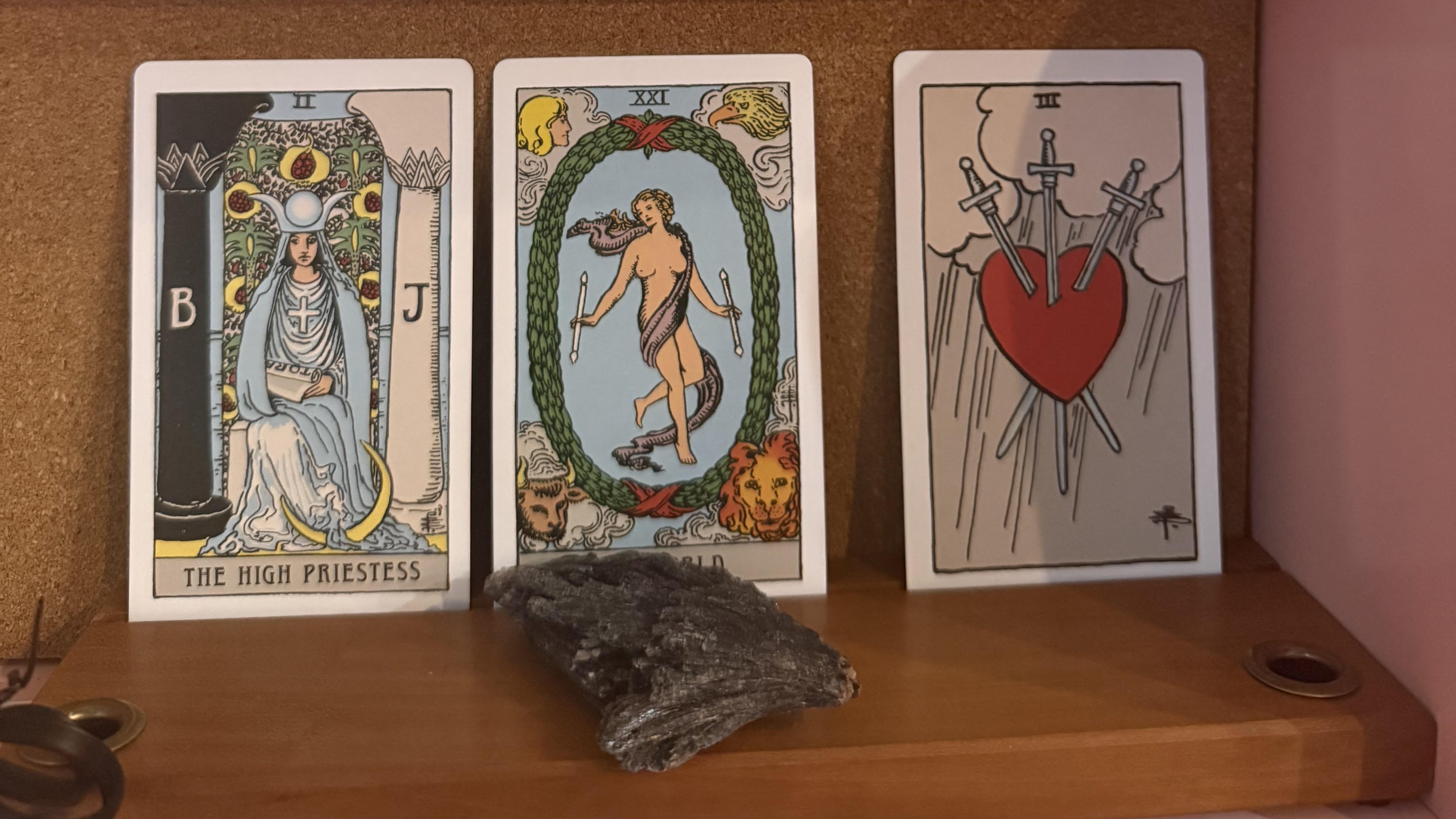
In the end, this approach helps me open my mind, focusing less on having the correct answer and moreso using the right knowledge and tools to compellingly interpret the scene in front of me.
I encourage you to try out this storytelling method and see if it works for you. Always feel free to reach out if you are interested in discussing techniques.
 Ruby White - Tarot & Oracle Reading
Leave a comment